Resilience and rebound: Q4 in review and property outlook for 2026


Teleisha Thomas
January 2026Eliza Owen is a leading housing market commentator with more than a decade of experience analysing property market trends. Formerly Head of Research at Cotality, she offers an informed perspective shaped by year-on-year market shifts. In this update, Eliza examines the latest Victorian data and what it signals for buyers and sellers entering the 2026 property market.
The Victorian housing market staged a strong recovery in 2025, with home values climbing 5% statewide, according to the Cotality Home Value Index. This rebound follows a 1.9% decline in 2024, underscoring a clear shift in market conditions. Quarterly growth eased to 1.0% in December after a 1.5% rise in September, yet selling conditions at year’s end were markedly stronger than a year earlier.

Victorian property market at a glance: December 2025
Regional Victoria outshines Melbourne
Regional markets stole the spotlight in the December quarter, posting a 2.5% gain versus 0.8% across Greater Melbourne. Strong internal migration underpinned this surge, with a gain of 6,629 people to regional Victoria in the year to June, largely from Melbourne, NSW, and Tasmania. Ballarat was among the top growth spots in 2025, with home values up 11.8%.
The Jellis Craig network reflected very strong results, with the regional median sale price across houses up 4.9% in the December quarter, to $946,000. The median unit price was up 25.1% in the quarter, to $698,000. This reflects a mix of rising demand, and buyer activity being increasingly concentrated in desirable lifestyle markets.

Melbourne’s mixed signals
Melbourne’s market softened late in 2025, with the month of December recording a 0.1% dip in home values. This was the first monthly decline since January. Auction clearance rates slid from a high of 72% in late September to 58% by year-end. The Jellis Craig network posted a stronger auction clearance rate across the state, of 77% for the December quarter. This suggests quality, well-presented homes with a strong campaign can still see success on auction day, even when market conditions broadly become more challenging.
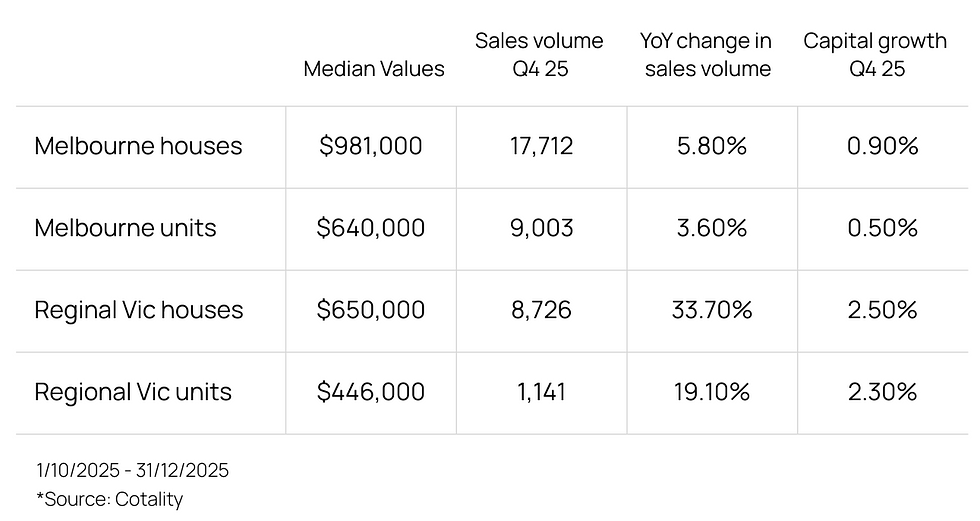
Cotality data shows houses outperformed units in the quarter, rising 0.9% across Melbourne compared to a 0.5% rise in units. As of December, the median house value in Melbourne reached $981,000, compared to $640,000 for the median unit.
Data indicated the Jellis Craig sale price results, concentrated in premium inner city, inner north and east Melbourne, outperformed conditions in the broader Melbourne market. The median sale price for houses was $1,725,000, up 1.0% from the previous quarter, while the median unit sale price rose 1.3% to $905,000.

Sales activity: Solid finish despite headwinds
Cotality estimates 36,582 homes sold in Victoria during Q4, up 11.2% year-on-year. Melbourne accounted for nearly 75% of transactions (26,715), with sales volumes up 5.1% on Q4 2024. Jellis Craig offices saw a much stronger sales uplift in Melbourne through the quarter, rising 18.3% on Q4 2024.
Listings remained tight in Melbourne through the same period, with Cotality data showing stock levels were 11.5% below the 5-year average at the end of 2025. At the same time, Jellis Craig offices saw a 6.7% boost in attendance at open homes in Melbourne through the quarter, and a 9.4% reduction in average selling times. This suggests tight stock levels have made it quicker and easier for Melbourne vendors to sell their properties.
Regional Victoria saw a remarkable surge in activity, with 9,867 sales in the December quarter, up 31.9% year-on-year. Total stock levels dipped 7.7% from the end of 2024. Jellis Craig network data indicated a 14.5% drop in the average time to sell a property in regional areas during the December quarter, as average attendance at open homes jumped 13.9%. In other words, the regional Victorian property market is now firmly in the hands of sellers.
Looking ahead: 2026 market outlook
While some headwinds may temper housing demand early in 2026, such as the potential for cash rate increases and tighter credit standards, the outlook remains resilient. Any downturn is expected to be mild and largely confined to Melbourne’s high-end segment.
For sellers, conditions remain encouraging: regional Victoria continues to benefit from strong migration, affordability, and lifestyle appeal, all of which are set to sustain demand throughout the year. Melbourne homeowners can enter 2026 with confidence. Market fundamentals remain solid, and the broader trend points to stability rather than significant decline.
Written by Eliza Owen, Housing Market Analyst & Economic Commentator




