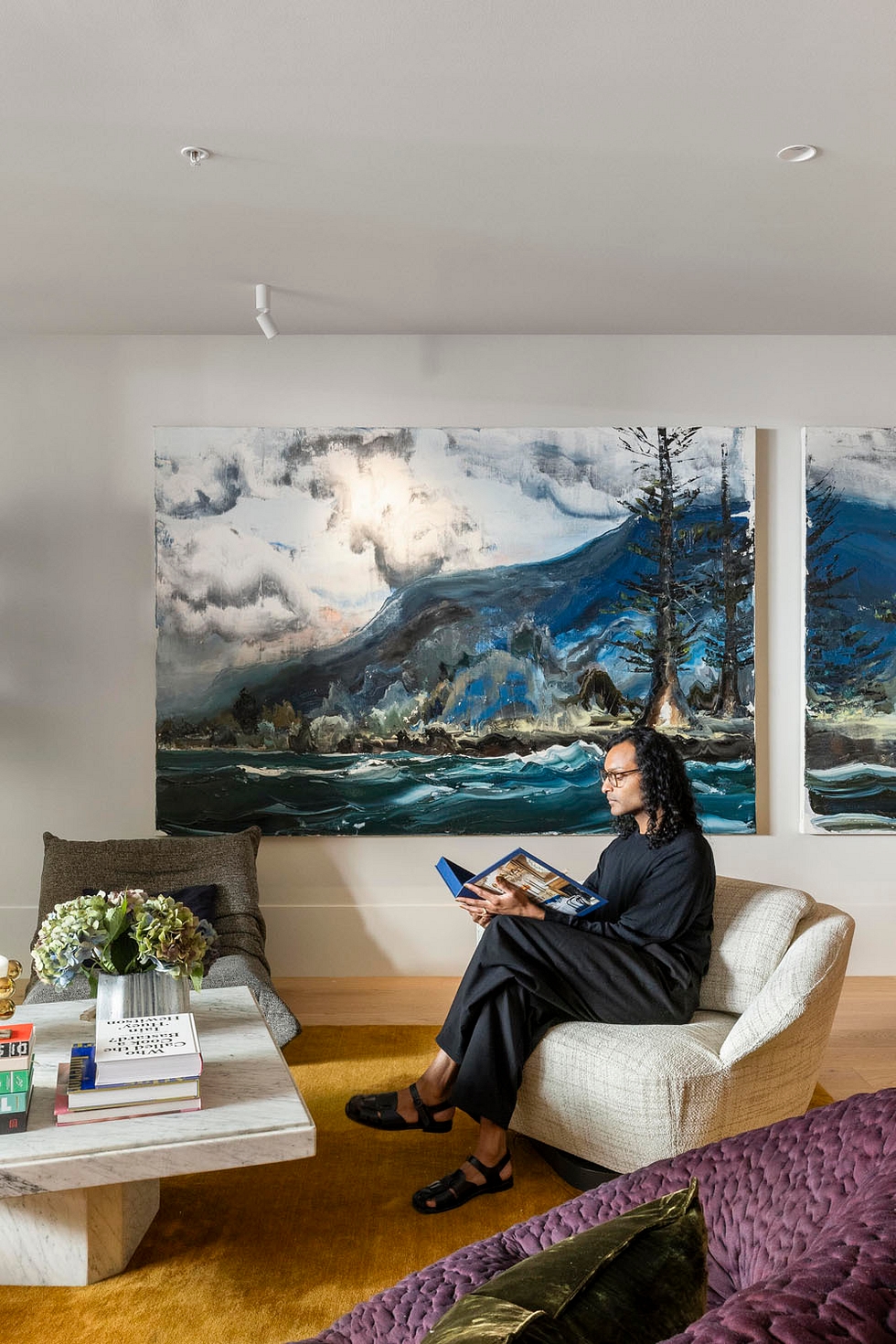
How interior designer Brahman Perera transformed a Fitzroy apartment

Teleisha Thomas
June 2026Melbourne-based interior designer Brahman Perera has become one of the most sought-after names in Australian interiors, earning his place on the industry's most respected lists and building a body of work that spans residential homes to boutique commercial interiors with equal command. We talked to Brahman to learn how he made this off-the-plan Fitzroy apartment his own.

Melbourne-based interior designer Brahman Perera has become one of the most sought-after names in Australian interiors, earning his place on the industry's most respected lists and building a body of work that spans residential homes to boutique commercial interiors with equal command. We talked to Brahman to learn how he made this off-the-plan Fitzroy apartment his own.
Image credit: Eve Wilson

Architecture by Woods Bagot - Interior Design by Hecker Guthrie & Brahman Perera - Landscape Design by Acre – Build by Piccolo House.
If the Melbourne suburb of Fitzroy were a brief, how would you describe it? And how does this apartment respond to that brief?
Eclectic! Fitzroy is layered, and slightly contradictory - there’s a strong historic grain, but it’s constantly being reinterpreted. It has a looseness to it, but also a sense of density and culture that’s quite specific. The apartment responds by not trying to compete with that. Instead, it takes a more restrained position internally, focusing on proportion, material depth, and clarity - so that the life of the neighbourhood can remain the more expressive layer. It’s less about mirroring Fitzroy, and more about framing it. You have described the terrace as offering a way to engage with Fitzroy's rhythm without being fully exposed.
How has living here influenced your practice of designing urban spaces?
Yes, particularly in how thresholds are handled. Urban living is often about negotiating proximity - to people, to movement, to noise. The terrace works because it filters rather than blocks. That idea has definitely influenced my broader thinking - creating spaces that allow engagement without requiring full exposure. It’s a more nuanced approach to privacy. The terrace is cleverly designed above the pavement, and with a deep lush planter box and lighting; it gives the feeling of being elevated and private, despite the fact we are actually close to the ground floor.
Which local designers or brands do you find yourself reaching for?
There’s a strong community of makers in Melbourne, and I tend to gravitate towards those who have a clear material sensibility. Studios like Zenn Design who made our beautiful bed, alongside others working in timber, metal, and textiles, offer a level of nuance that’s difficult to replicate at scale. We often collaborate with Volker Haug for lighting, Ma House for styling, Mondopiero for home accessories, and ceramicist Alex Cerny.

Every home has those furniture pieces you would move heaven and earth to keep. What are yours here?
The piano is non-negotiable - it moves with us and defines how we occupy a space. It’s less about its form and more about what it enables - music as a background to our lives, a sense of calm and respite from the tech-filled world we live in. The Albero bookcase is another. It has a strong presence, almost architectural, and the fact that it rotates gives it a level of interaction that most furniture doesn’t have. Those pieces tend to stay because they continue to offer something over time.
What's one design rule you swear by, and one you love to break?
I tend to rely on proportion as a guiding principle - if the proportions are resolved, most other decisions become clearer. As for rules to break - the idea that spaces need to be complete or fully resolved. I think a certain level of incompleteness allows a home to evolve and remain connected to the person living in it.
Art feels like the real anchor of this home. How do you approach collecting? Is it instinctive, or is there a method to it?
It’s largely instinctive, but over time patterns emerge. I’m drawn to works that hold a certain tension, whether that’s through material, composition, or subject. I don’t tend to collect with a fixed outcome in mind. The pieces accumulate, and the relationships between them develop over time. That’s what gives a home a sense of authorship rather than decoration.
Tell us about the light pendants you have designed.
They’re relatively simple in form but considered in proportion and material so they feel integrated rather than applied. My pendants are in constant evolution. Currently I'm working on an upturned floor lamp, playing with transparency and drama, alongside a short fat table lamp that has great presence. All on show at Oigall Gallery a short walk away from the apartment.
The green timber core that wraps the bedroom and bathroom is a distinctive feature. How did that idea come about?
It came from a desire to give the apartment a centre of gravity. New-build apartments can often feel dispersed or overly neutral, so introducing a defined core creates both contrast and orientation. The material choice - a deep green timber veneer - was about adding weight without heaviness. It allows the core to read as something intentional and architectural, rather than purely functional, and it ties back directly to the gorgeous kitchen joinery, and colour saturation of the bathroom.

g05/385 Gore Street, Fitzroy is currently on the market with Jellis Craig Inner North. Contact Charles Atkins
Neighbourhood favourites
Best coffee: Napier Quarter
Favourite dinner / nightcap: Zareh / Marion
Favourite furniture/homewares boutique: Ma House
Weekend activity: Walking between Fitzroy and Carlton, usually without a fixed destination - puppies and an iced long black!