

While Victoria's property investors have faced recent headwinds from tighter rental reforms, additional land tax, and higher interest rates, the landscape is changing rapidly, and positive opportunities are emerging in the current market.
Victoria's rental market strength
The supply and demand equation has
moved in favour of rental providers. While
conditions are difficult for many renters,
the increasing population in tandem
with the rental housing shortage has put
upwards pressure on market rents. Not
only has Victoria delivered strong rental
growth for landlords since 2020, but the
gross rental yields for rental providers
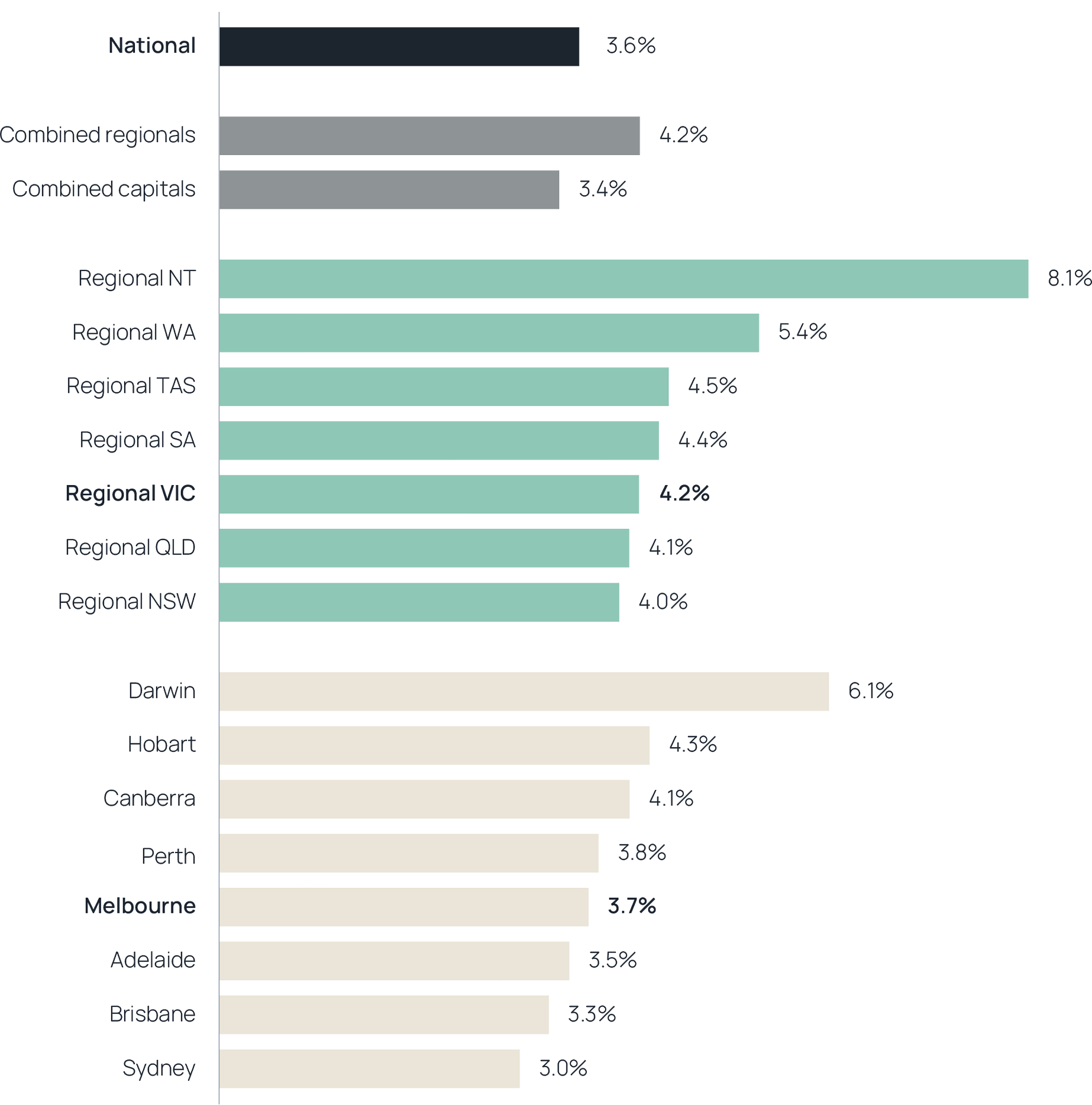
have also increased. From a capital city
point of view, Melbourne's median rental
yield has historically sat around 3.1%,
second lowest to only Sydney's since the
market peak in 2022. With static capital
growth, a shrinking rental property pool
and rising rents, Melbourne's gross
rental yield median now sits at 3.7%,
higher than Sydney, Brisbane, and
Adelaide. With these increased returns
for investors, Victoria has experienced
strong demand throughout the last two
years from interstate rental providers.

February 2025
Gross rental yields, dwellings
Source: Cotality, February 2026
Interstate investors take notice
While WA, NT, SA and QLD's capital
values surged during Victoria's static
phase, Melbourne now presents a
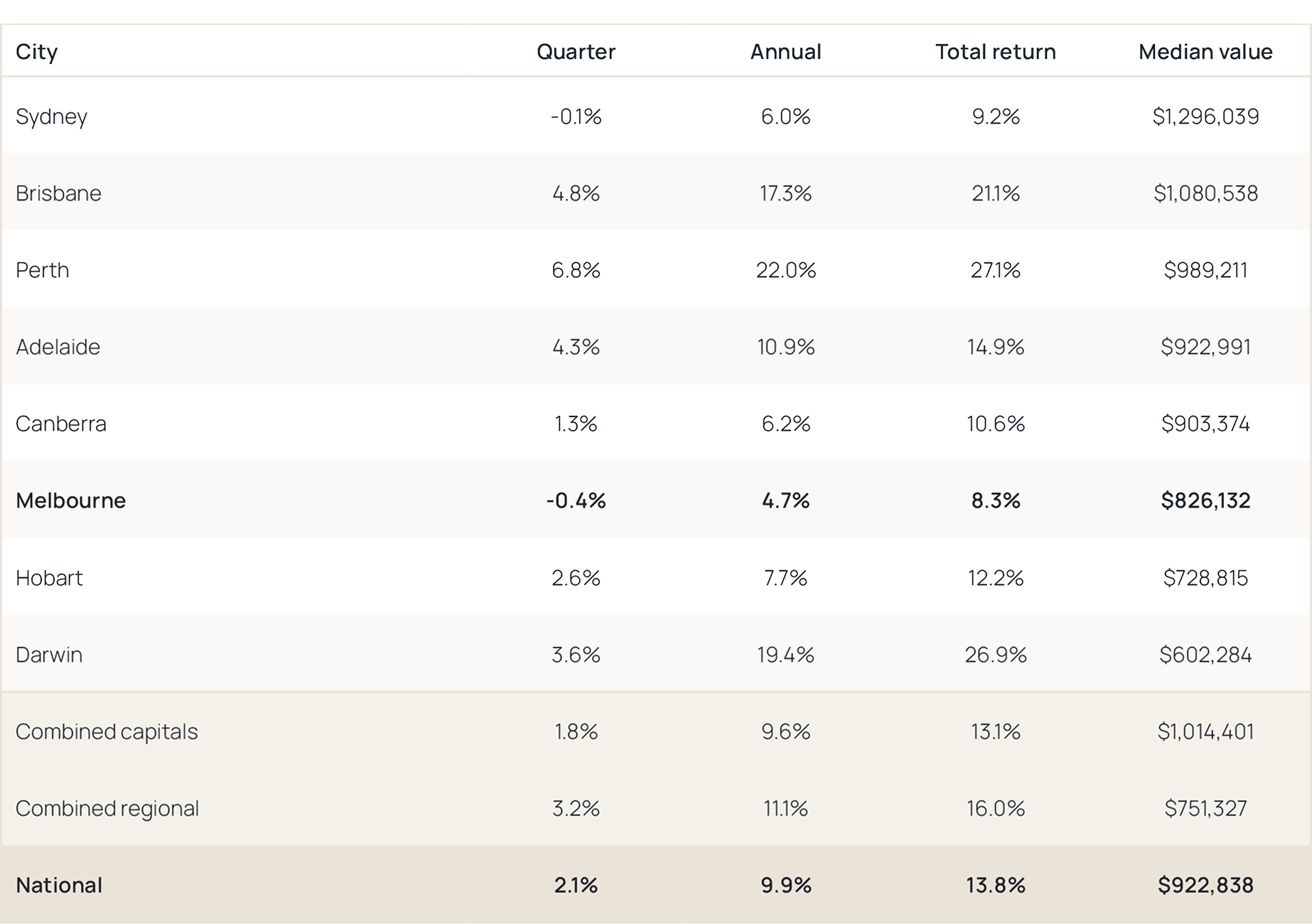
compelling value proposition. With five of
our capital cities' median dwelling prices
now more expensive than Melbourne's,
the nation's second-largest city offers
arguably the best opportunity in the
country.
Some investors subscribe to the mean
reversion theory; mean reversion implies
that an asset's value will return to its
historical mean over time. In the case
of Melbourne's property market, the
ratio between other capital city values
and Melbourne's values are currently
at historical highs, suggesting that the
various ratios will eventually return to
historical norms. Melbourne's relative
value, when contrasted against other
capital cities is viewed opportunistically
by many investors.
With five of our capital cities' median dwelling prices now more expensive than Melbourne's, the nation's second-largest city offers arguably the best opportunity in the country.
Change in dwelling values
Source: Cotality, Index Results as at 28th February 2026
Private investors represent the lion's share when it comes to providing housing. Less than one in ten rental properties are owned by the government.
Tax benefits for property investors
Aside from the capital growth and
rental returns, investors also benefit
from negative gearing and depreciation
tax benefits. Our federal government
recognised long ago that housing is
a shared burden for both the states
and private investors. In fact, private
investors represent the lion's share
when it comes to providing housing.
Less than one in ten rental properties
are owned by the government.
Negative gearing was introduced in Australia 90 years ago to promote housing construction. While it's a popular election topic, and one of consistent social debate, the reality is that our governments (both State and Federal) have saved significant money by apportioning a large responsibility of housing to private investors.
Effective losses are recognised by the ATO, and these losses are partially offset with a reduction in tax payable. Depreciation considers the wear and tear of the materials within a property. These are considered as losses, and as such, investors can also claim a reduction in their tax bill based on the depreciable components of their property and the associated cost to replace them. While reduced taxes are a benefit, they should never be a reason to invest.
Property investment is complex, and it is never a one-size-fits-all approach. Property investors often approach the task with the quest for the "Holy Grail"; high capital growth, high rental returns, low market volatility risk, and high rates of tax benefits. Unfortunately, this approach is flawed, as the four attributes can't be achieved in unison.
Location and property fundamentals
Typically, a well-located property
with access to cafes, schools, public
transport, parks/water and lifestyle
amenity will perform well in the long
term. But aspects such as street appeal,
demographic profile, suburb crime rates,
financial outgoings, dwelling quality,
floorplan, orientation and noise all have
a bearing on the asset's growth rate.
A skilled investor will be able to identify gentrifying areas based on statistical evidence and planning/civil infrastructure advancements. Whether it be an established ‘blue chip' area, or a lucrative ‘up and coming' location, outperforming capital growth is the prize.
Many investors assume that land size is key to capital growth. However, land value is the critical ingredient. Whether the land is a 100 sqm parcel in the inner ring or a 700 sqm block in the outer ring has no bearing on the capital growth prospects. The other attributes must align for a property to outperform.
The role of property management
An important consideration in our
current market relates to rental
compliance and minimum standards.
The costs to rectify a property that
doesn't meet minimum rental standards
can erode profits quickly if the dwelling
is in poor condition. The need for clear
direction from property management
professionals has never been more
important. Property managers can assist
not only with the selection of a suitable
renter and effective communication
between the parties. Nowadays they are
a valuable resource for supporting their
rental providers with compliance checks,
advice on improvements, and assistance
with meeting minimum rental standards.
While I've discussed Victoria's recent headwinds, our city remains favourable for investors for many reasons. The long-term outlook is enormously positive. Civil infrastructure investment has been considerable over the last decade, from hospitals to roadways, tunnels, and expanded rail networks. Forecasted population growth will see Melbourne outpace Sydney in the next decade, and our regions will continue to benefit from skilled migration and exciting masterplans.
Melbourne was ranked fourth in the world's most liveable city by The Economist in 2025, and for good reason. Relative affordability, our European café culture and sporting appeal will continue to hold our beautiful city in high stead for decades to come.